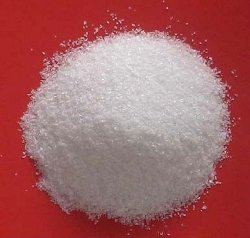
Flocculents
Flocculation , in the field of chemistry , is a process where colloids come out of suspension in the form of floc or flakes. The action differs from precipitation in that, prior to flocculation, colloids are merely suspended in a liquid and not actually dissolved in a solution . In the flocculated system there is no formation of a cake since all the flocs are in the suspension.
Particles finer than 0.1 µm (10 -7 m) in water remain continuously in motion due to electrostatic charge (often negative) which causes them to repel each other. Once their electrostatic charge is neutralized by the use of coagulant chemical, the finer particles start to collide and agglomerate (combine together) under the influence of Van der Waals 's forces. These larger and heavier particles are called flocs. Flocculants, or flocculating agents (also known as flocking agents), are chemicals that promote flocculation by causing colloids and other suspended particles in liquids to aggregate, forming a floc. Flocculants are used in water treatment processes to improve the sedimentation or filterability of small particles. For example, a flocculant may be used in swimming pool or drinking water filtration to aid removal of microscopic particles which would otherwise cause the water to be turbid (cloudy) and which would be difficult or impossible to remove by filtration alone.
Typical Applications:
* Purification of drinking water
* Sewage treatment
* stormwater treatment and treatment of other industrial wastewater streams