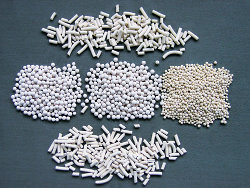
Molecular Sieves
A molecular sieve is a material containing tiny pores of a precise and uniform size that is used as an adsorbent for gases and liquids . Molecules small enough to pass through the pores are adsorbed while larger molecules are not. It is different from a common filter in that it operates on a molecular level and traps the adsorbed substance. For instance, a water molecule may be small enough to pass through the pores while larger molecules are not, so water is forced into the pores which act as a trap for the penetrating water molecules, which are retained within the pores. Because of this, they often function as a desiccant . A molecular sieve can adsorb water up to 22% of its own weight. The principle of absorption to molecular sieve particles is somewhat similar to that of size exclusion chromatography , except that without a changing solution composition, the adsorbed product remains trapped because in the absence of other molecules able to penetrate the pore and fill the space, a vacuum would be created by desorption. Often they consist of aluminosilicate minerals , clays , porous glasses , microporous charcoals , zeolites , active carbons , or synthetic compounds that have open structures through which small molecules, such as nitrogen and water can diffuse.
Typical Applications:
* Petroleum industry, especially for the purification of gas streams
* chemistry laboratory for separating compounds
* drying reaction starting materials