IX Resins
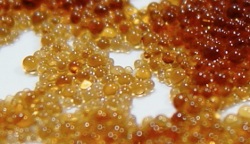
An ion-exchange resin or ion-exchange polymer is an insoluble matrix (or support structure) normally in the form of small (1–2 mm diameter) beads, usually white or yellowish, fabricated from an organic polymer substrate. The material has highly developed structure of pores on the surface of which are sites with easily trapped and released ions . The trapping of ions takes place only with simultaneous releasing of other ions; thus the process is called ion-exchange . There are multiple different types of ion-exchange resin which are fabricated to selectively prefer one or several different types of ions. Ion-exchange resins are widely used in different separation, purification, and decontamination processes. The most common examples are water softening and water purification . In many cases ion-exchange resins were introduced in such processes as a more flexible alternative to the use of natural or artificial zeolites .
There are four main types differing in their functional groups :
- strongly acidic (typically, sulfonic acid groups, e.g. sodium polystyrene sulfonate or polyAMPS )
- strongly basic, (quaternary amino groups, for example, trimethylammonium groups, e.g. polyAPTAC )
- weakly acidic (mostly, carboxylic acid groups)
- weakly basic (primary, secondary, and/or ternary amino groups, e.g. polyethylene amine )
Typical Applications:
* Water softening
* Water purification
* Ion-exchange in metal separation
* Catalysis
* Juice Purification
* Sugar manufacturing
* Pharmaceuticals